Introduction: What separates a good campaign from one that deserves an award? How do you capture the attention of an audience caught in an endless scroll? And where do we draw the line between AI as a creative collaborator and AI that slowly pulls everything towards the same average?
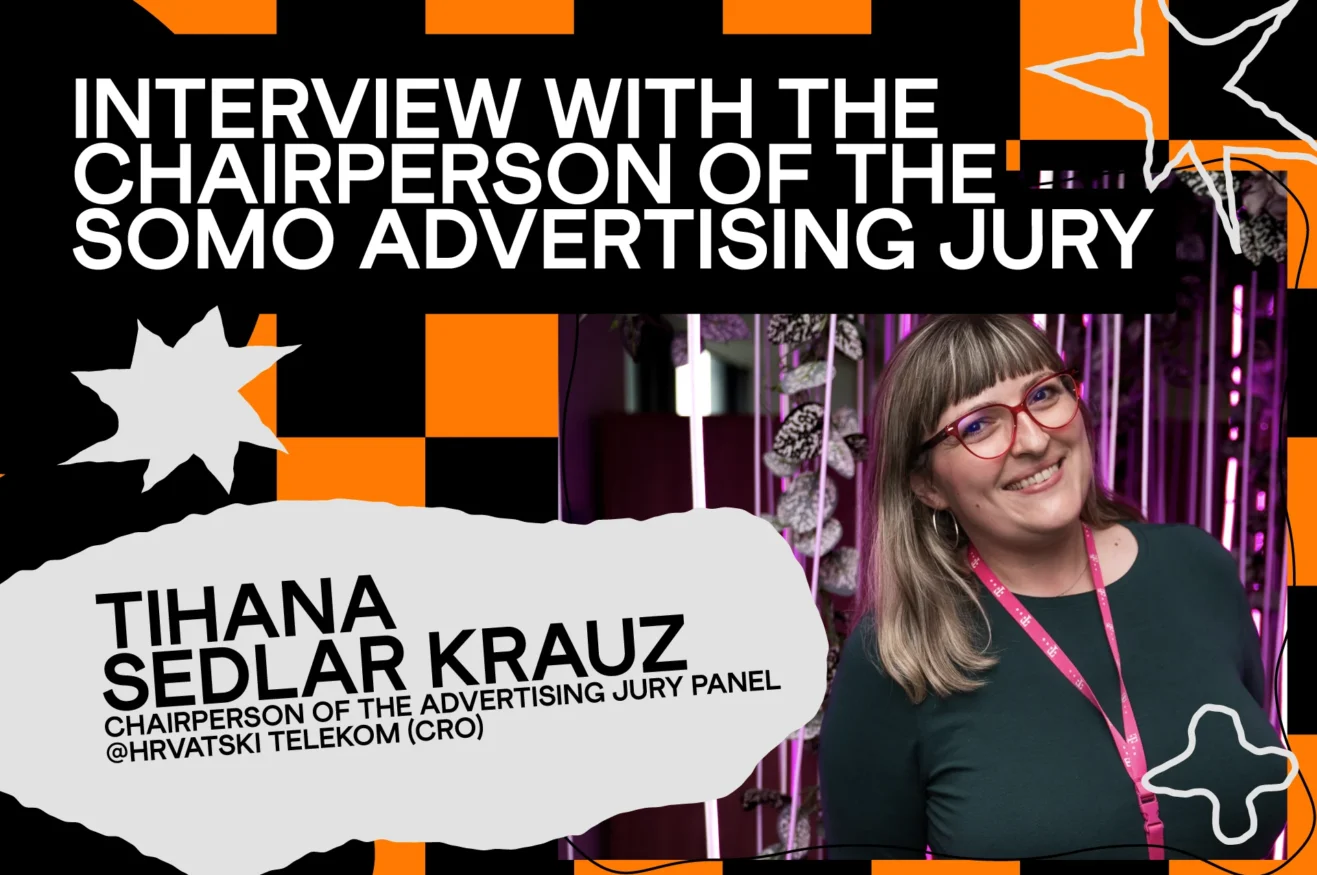
Every year, dozens of entries pass through the hands of the SoMo Borac jury, as the region’s most relevant competition continues to recognize and reward the best digital projects. Ahead of its upcoming 14th edition, which the organizers are billing as the strongest yet, we spoke with Tihana Sedlar Krauz, this year’s Chairperson of the SoMo Advertising Jury Panel, to find out what makes one campaign stand out from the hundreds of others competing for the same increasingly scarce audience attention.
Tihana leads digital marketing, social media and content production at Hrvatski Telekom, and when judging campaigns, she has been looking for the same thing for years: a clear connection between a creative decision and the business result it helped generate. We spoke with her about why originality today is, above all, a matter of discipline, where artificial intelligence stops being a tool and starts becoming a threat to the creative idea, how difficult it is for brands to stay true to themselves amid rapidly changing trends, and what separates a winning piece of work from one that is simply good.
Read the full interview below.
- SoMo Advertising rewards work that successfully combines originality, quality of execution, and business results. Is it more difficult today than it used to be to strike a balance between creative originality and genuine business effectiveness? And what separates a “good” campaign from one that deserves an award?
I would say it is much harder today. Creativity has not become rarer, but in the sea of content bombarding us from all directions, it is simply much harder to stand out, and to come up with a genuinely original idea. When anyone can publish content in a second, originality stops being just a question of the idea and becomes a question of discipline: will a brand stick to its story long enough for the market to recognize it? Will it be brave enough, or will it simply disappear into everything we are exposed to the moment we look at a screen or glance around us?
What separates a good campaign from an award-winning one comes down to a simple question: was the creative solution necessary to achieve the business objective and make a difference, or was it simply an addition to something that would have happened anyway? Liquid Death is an excellent global example. Its absurd, provocative aesthetic is not decoration; it is the entire business model of a canned water brand that behaves like an energy drink for skaters. Without that creative decision, there would be no $1.4 billion brand. When judging, I always look for that cause-and-effect connection: creativity that created an exceptional result, rather than creativity that simply accompanied it.
- In a digital environment flooded with content and short attention spans, is creativity becoming more important than ever, or is its role changing?
Its role is changing significantly. Creativity is no longer just a tool for making a message memorable; it is becoming a tool for stopping the endless scroll. That is a completely different discipline from the one on which classical advertising theory was built. Attention data, including research by System1 and Adelaide on attention quality, shows that the first one or two seconds can no longer simply “introduce” the idea; they have to be the idea.
That is why the best campaigns today do not think in terms of “scenes,” but in terms of hooks that work without sound, without context, and without the viewer even intending to watch. Ryanair’s deliberately unpolished, self-deprecating tone on social media, for example, is no less creative than a traditional ad. Quite the opposite: it requires a more precise creative decision because there is no time for an introduction. Creativity has not become less important; it has simply taken on a completely different form.
- Artificial intelligence has become an everyday marketing tool, from ideation to content production. Where do you see the line between AI that enhances creativity and AI that risks making it predictable and generic?
The line becomes clear as soon as you ask who is making the decision about meaning and who is making the decision about execution. AI is an excellent collaborator when it speeds up production, broadens perspectives, conducts research, tests variations, or personalizes an existing creative idea across a large number of formats. AI is also great if you want to check whether your idea has already appeared somewhere else in the world. The problem begins the moment AI starts making the creative decision instead of a human, because by definition, the model generalizes toward the average of everything it has seen, and award-winning work always breaks away from the average.
Two global examples illustrate this well. Coca-Cola’s 2024 AI Christmas ad is technically flawless but emotionally empty because the algorithm reproduced the style of a familiar campaign without understanding why the original worked, something also reflected in the comments on social media. Heinz, on the other hand, used the same technology in a completely different way in 2022. It asked the public to enter only the word “ketchup” into an AI tool and let AI “draw” bottles that almost always resembled the Heinz label. There, AI was not creating the creative idea; it was proving an existing one: that the brand is so deeply embedded in our collective consciousness that even a machine recognizes it. That is the difference between AI as the source of an idea and AI as proof of an idea.
- The TikTok category rewards consistency over a longer period. How difficult is it for brands to maintain their own distinctive style on TikTok while keeping up with rapidly changing trends?
Extremely difficult, which is exactly why consistency on TikTok is a rarer and more valuable skill than the creativity of a single video. A trend is borrowed time: you are using a widely recognized format to secure attention, but if the brand gets lost within it, the viewer remembers the trend, not the brand. The real test is not “did we use the trend?” but “would people recognize this video as ours even without the logo?”
Scrub Daddy and Ryanair are almost textbook global examples: both brands live within daily trends, yet they have such a clear, almost repetitive voice – ironic, self-aware, and sometimes deliberately rude – that the voice remains recognizable even when the format is borrowed. Consistency on TikTok, then, does not mean doing the same thing over and over again. It means speaking with the same character through every new thing you do.
- In recent years, Croatia’s digital scene has shown that it can create projects capable of competing internationally. As a jury member, what interests you more: a project with a clear local or regional identity, or one that boldly reinterprets global trends?
Naturally, I always prefer to see a project with a clear local or regional identity. But I am particularly interested in projects that do not choose between the two and instead prove that the best “global” content is actually content that has been perfectly contextualized at a local level. Audiences today immediately recognize a generic global message, which is exactly why specific, authentic Croatian humor, references, or emotions can often travel better across borders than a generic attempt to appeal to everyone.
That is the logic behind phenomena such as Spotify Wrapped: it is a global format, but each market team brings it to life locally through culturally specific references, making it feel personal in every country. That is what I hope to see here as well: the courage not to imitate a global trend, but to tell a local story with such precision that it becomes universal precisely because it is authentic.
- If you had to name one key characteristic you expect from this year’s winning SoMo Borac work, what would it be? And what could genuinely surprise you?
If I had to choose just one, it would always be courage justified by results, not just aesthetics. Work that is prepared to take risks, but can also support that courage with a clear business or social impact.
I would be delighted to see a project that does not come from a huge budget or a major brand, but from a team that turned its limitations into a creative advantage. Some of the most awarded solutions emerge precisely when there is no large production budget, and a great idea is something a big budget often cannot compensate for.
- What message do you have for agencies and brands submitting their work, and what would you like to see more of among the projects presented to the jury?
The message is simple: submit the work because of the results it achieved, not because of how good it looks in the entry. We have seen too many campaigns that are creatively flawless in their presentation but lack a clear connection to the business or social change they actually created.
I would like to see more projects openly show what did not work the first time: the iterations, testing, and adjustments made in response to real audience reactions. That is the process that actually sits behind the best digital campaigns today, and I think that kind of transparency would raise the level of professionalism across the entire scene, not just the level of aesthetics.