23. July 2026.
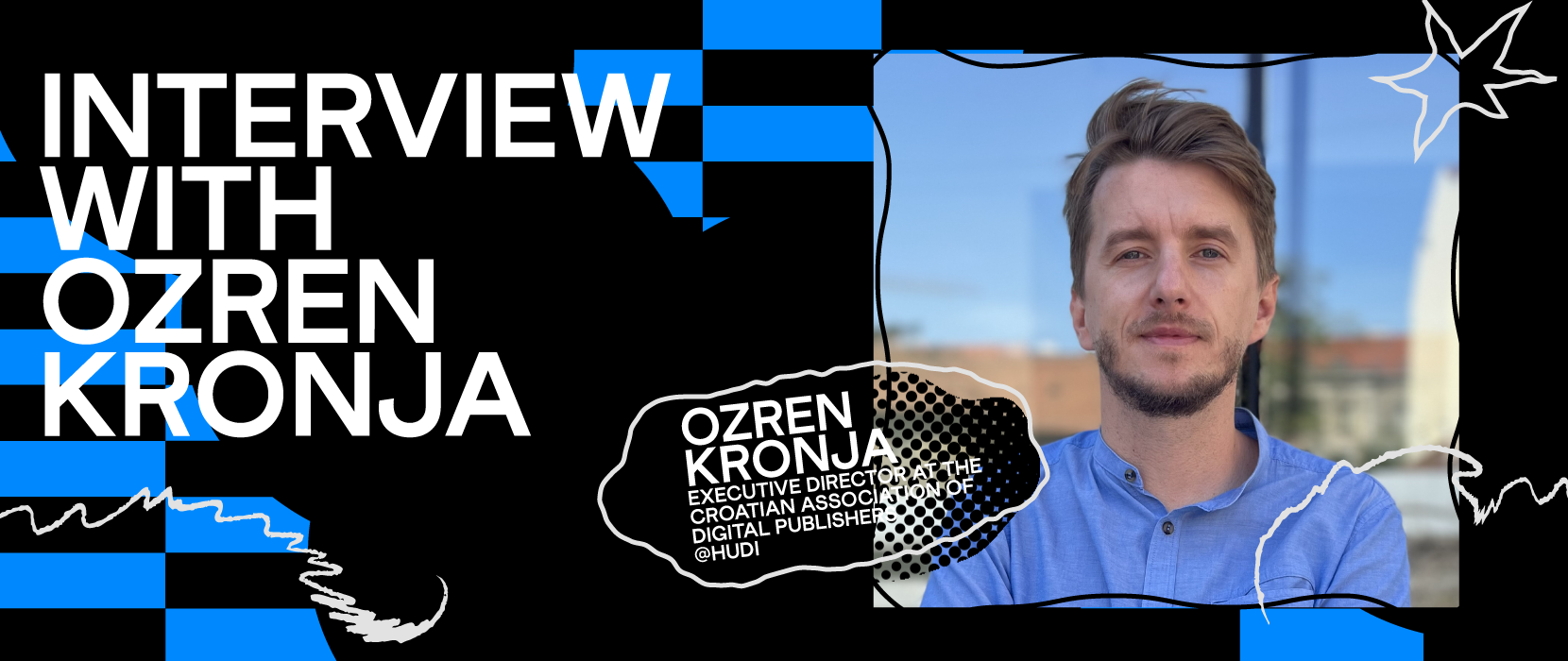
Ozren Kronja (HUDI): AI won’t replace great ideas
Artificial intelligence is transforming the way we create content, build campaigns and develop digital products. But where does AI stop being a useful tool and start becoming a threat to authenticity? What lies ahead for the media industry, and what kinds of projects stand out in today’s digital landscape?
Ahead of this year’s SoMo Borac, we spoke with Ozren Kronja, Executive Director of the Croatian Digital Publishers Association (HUDI) and one of the competition’s co-organisers. In the interview, he shares his views on AI and media, discusses the biggest challenges facing the industry, explains the HUDI North Star category, and reveals what this year’s jury will be looking for.
Read the full interview below:
Ozren Kronja (HUDI) ahead of SoMo Borac: We’re looking for game changers who can show us how to survive AI disruption
SoMo Borac is the region’s most relevant competition, having recognised and rewarded the best digital projects for years. Ahead of its 14th edition, which the organisers have announced as the strongest yet, we spoke with Ozren Kronja, Executive Director of the Croatian Digital Publishers Association (HUDI), one of the competition’s co-organisers. Kronja discussed what is new in this year’s competition, shared his views on the relationship between artificial intelligence and newsrooms, explained where AI stops being a useful tool and starts posing a risk to content authenticity, and why the media should not be afraid of new technologies. He also revealed what kinds of projects HUDI is looking for in the HUDI North Star category and shared key advice for creating an entry that will capture the jury’s attention.
- What does the coexistence of AI and regional newsrooms look like today? Where is the line between efficiency and the loss of authenticity?
AI is here to stay. Its impact can be felt across every aspect of society and every industry, not only the media. In newsrooms, the line between efficiency and the loss of authenticity is clear: as soon as AI takes on the role of author rather than tool, the content loses its authentic editorial voice and context, while the value of the information itself becomes highly questionable. We end up with aggregated opinions that lack clear direction, vague and lukewarm conclusions, and information that is simply inaccurate. AI tools are excellent for fact-checking and proofreading, research, summarisation, adapting copy to a publication’s format and style, and data analysis. Ultimately, however, a human must give the text meaning, purpose and a coherent structure.
- Should traditional media be afraid of AI? Why?
Absolutely not. Fear is the mind-killer. However, working methods need to adapt, and the industry must remain open-minded when exploring the full range of possibilities AI offers. In the media industry, these possibilities are numerous, from supporting content creation and optimising processes to making more effective use of data.
The real challenge today is the unauthorised use of media content to train AI models, as well as the presentation of summaries without adequate attribution or compensation. This directly harms media organisations by cannibalising traffic, reducing advertising revenue and threatening the long-term sustainability of the entire industry. That is precisely why clear protective rules are needed at EU level. Important steps have already been taken through the AI Act, the Copyright Directive, the Digital Services Act and the European Media Freedom Act.
Without this kind of protection and regulation, we risk a scenario resembling the well-known Dead Internet Theory. The theory, which began circulating around a decade ago, predicts that most online content will eventually be created by bots rather than people. If we allow that to happen, the internet will become little more than a recycled repetition of existing AI-generated content, with no new knowledge, no fact-checking and no real value for people.
- AI has also made a major entrance at SoMo Borac this year. How important is it for the industry to keep up with AI trends and tools? How can these tools be used most effectively?
The greatest strength of artificial intelligence lies in its plasticity, or adaptability, just as with natural intelligence. AI tools can be used in many different ways, but every company, regardless of the industry it operates in, must first focus on its own needs, challenges and opportunities. Only then should it define its goals and consider how AI fits into the bigger picture. People forget that AI is only a tool. An exceptionally powerful one, but still only a tool. A company’s success will not come from how much it uses AI, but from how and why it uses it. In other words, the formula for success has not changed: if you have a strong strategy and a clear vision, you will prosper, and AI will simply accelerate your growth.
- This year, HUDI is placing a strong emphasis on media innovation through SoMo Borac. What exactly are you looking for in the HUDI North Star category?
HUDI North Star rewards projects and initiatives that strengthen the independence and innovative capacity of Croatia’s digital ecosystem. When reviewing entries, it is not only important to identify projects that are already successful today, but also those that demonstrate the greatest potential. We want to highlight projects that are genuine game changers in the age of AI disruption, and whose results could contribute to the long-term sustainability and innovation of the media industry.
- Can you give three quick pieces of advice to those currently preparing their HUDI North Star entries? What will the jury value most?
First and foremost, be bold and open-minded. Good innovators do not rely on a single idea. They test several different solutions until they find the winning one. Nominate interesting, out-of-the-box projects even if you are not completely certain about them. We assess potential.
Second, include the story of the community in your entry. HUDI represents Croatian media organisations and everyone involved in the media industry. That is why it is extremely important to explain how your project contributes, or could contribute, to the community, the market or the audience.
Third, look around you. Our daily workload often overwhelms us, leaving little time to question established practices or develop new, slightly unconventional and innovative solutions. Fortunately, our industry is full of different people with different ideas and solutions. Take a moment to stop and observe them. Perhaps one of those solutions could help you directly, or perhaps it is a project that truly deserves to be nominated.